

Last-Mile Delivery: The Maturity of Autonomous Robots
How Autonomous Delivery Robots Are Rewriting the Rules of the Last Mile
For decades, the most expensive stretch in the global supply chain wasn’t a transcontinental shipping lane or a cross-border customs checkpoint — it was the final two miles from a local warehouse to your front door. That deceptively short journey, known as the last mile, has historically swallowed profit margins, choked city streets with vans, and burned through enormous quantities of fossil fuels. By 2025, a quiet revolution on our sidewalks is changing all of that — one six-wheeled robot at a time.
Autonomous ground vehicles (AGVs) — compact, electric, sensor-laden robots — have graduated from Silicon Valley curiosity to genuine commercial infrastructure. They’re delivering burritos in Los Angeles, groceries in London, and medicines in Beijing. And unlike the flying drones that dominated the imagination of futurists a decade ago, these ground-based machines have proven something far more valuable than novelty: they actually work.
Table of Contents
From Sky to Sidewalk: Why Drones Lost the Last-Mile Race
The 2010s were the golden age of drone hype. Major retailers and logistics giants poured billions into unmanned aerial vehicles, envisioning a near future where packages rained from the sky into suburban backyards. It was an intoxicating vision — and one that repeatedly collided with physical and regulatory reality.
Drones face fundamental limitations. Maintaining lift, especially for payloads exceeding two kilograms, demands enormous energy, driving delivery costs to between $6 and $25 per drop in early trials. Then there are the regulatory barriers: airspace rules, requirements for visual line-of-sight operation, and the challenge of creating safe landing zones in dense cities. Drones have found genuine success in niche applications — delivering blood supplies in rural Rwanda, or urgent pharmaceuticals in suburban Texas — but universal urban deployment has remained elusive.
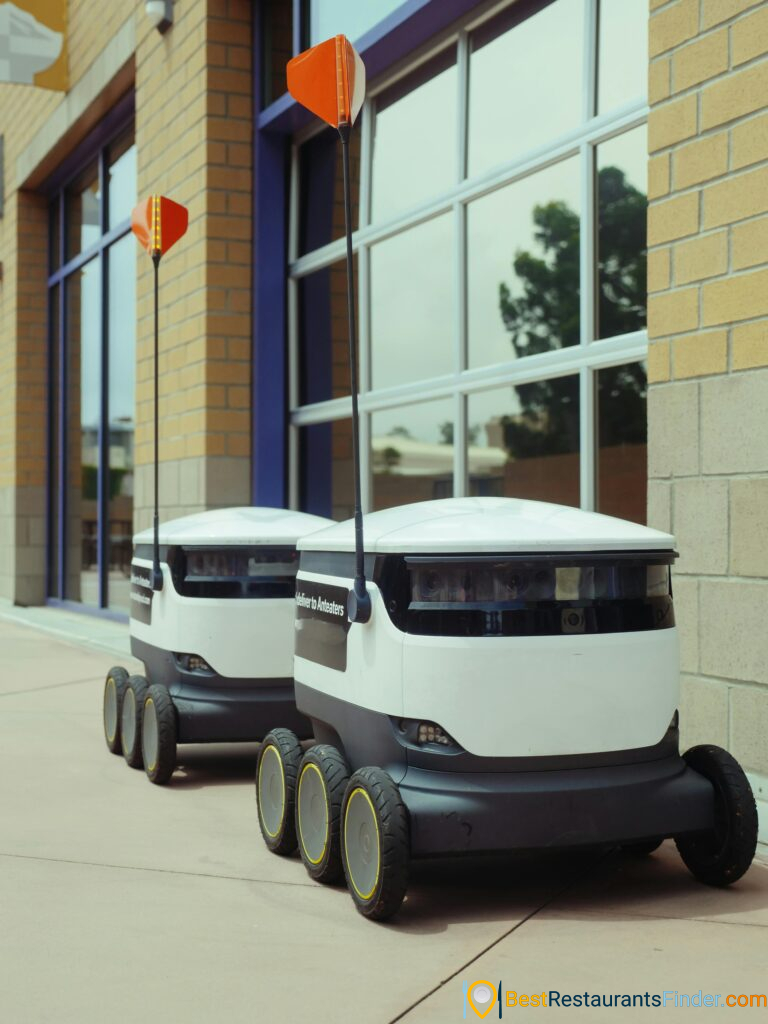
Ground robots, by contrast, use existing infrastructure. They navigate sidewalks, stop at crosswalks, and trundle up driveways just like a human courier would. Rolling on wheels requires a fraction of the energy needed for vertical lift, and research indicates that ground-based robots can achieve up to 94% lower energy consumption per package compared to conventional delivery vans.
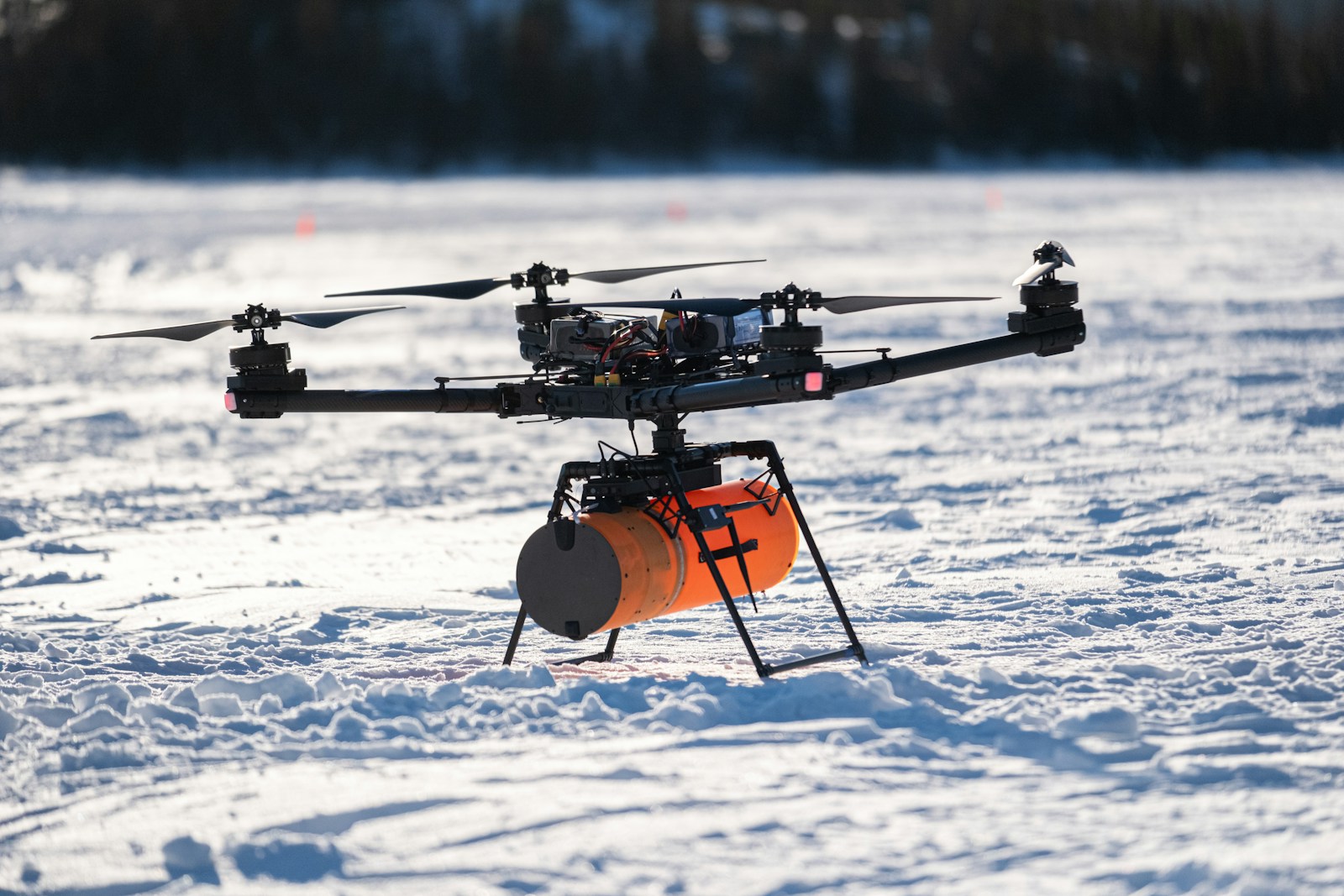
AGVs vs. Drones: A Head-to-Head Comparison of autonomous delivery technologies across payload, efficiency, regulation, weather, and cost.
AGVs vs. drones: a head-to-head comparison
The Economics: Breaking the Delivery Trap
Here is the uncomfortable truth that has haunted restaurants and retailers for years: in high-labor-cost markets, the average human-delivered order costs between $5 and $10 per drop — an amount that can easily exceed the entire profit margin on the food or goods being delivered. Increase order volume to grow revenue, and you may paradoxically shrink profitability. Industry insiders call this the “delivery trap.”
Autonomous robots disrupt this dynamic by converting a variable labor cost into a fixed capital cost. Early adoption data suggests robots already cost $3 to $4 less per delivery than their human counterparts. As fleets scale and AI navigation matures — eliminating the need for remote human supervision — that gap is projected to widen dramatically, with costs eventually falling to approximately $1 per drop.
The financial implications are staggering. Analysis from Barclays suggests that a $4 saving per delivery, at long-term market penetration levels, could unlock an annual global profitability pool of $16 billion for food delivery platforms alone.
Market Growth: From Pilot to Planet
The autonomous last-mile delivery market was valued at roughly $400–600 million in 2024–2025. Analysts project it will expand to between $5.5 billion and $11.5 billion by 2032–2035, supported by a compound annual growth rate estimated between 24.5% and 37.2%. North America currently holds the largest share at 44–47%, while the Asia-Pacific region — driven by urbanization in China and India — is expected to grow the fastest.
We are, in short, at the beginning of an inflection point. Penetration rates sit below 1% of global food deliveries today, but analysts forecast a jump to 10% by 2035 — at which point the cost of not using robots becomes a competitive disadvantage for any serious retailer or delivery platform.
Inside the Machine: How Modern Delivery Robots Work
Describing a 2025 delivery robot as a “rolling cooler” would be like calling a smartphone a “pocket calculator.” These are sophisticated autonomous systems operating at SAE Level 4 — meaning they can handle nearly all navigation and safety decisions within a defined geographic zone without any human intervention.
Sensor Fusion: Seeing the World in Real Time
To navigate an unpredictable city sidewalk — with its dogs, cyclists, strollers, and unpredictable pedestrians — robots deploy a multi-modal sensor array that creates a live 360-degree digital model of their surroundings:
- LiDAR Systems: High-frequency laser pulses map the environment in three dimensions, measuring precise distances to every obstacle in the robot’s path.
- AI Cameras: Identify semantic information — the state of a traffic light, a pedestrian’s likely trajectory, or a “Do Not Enter” sign.
- Ultrasonic and Radar Sensors: Provide redundant short-range detection, critical in fog, rain, or other low-visibility conditions.
Advanced deep learning models even allow robots to predict pedestrian intent — determining whether someone at a crosswalk is likely to step off the curb based on their head orientation and walking speed. This “intent prediction” capability, powered by 5G connectivity and edge computing, represents a genuine leap beyond simple obstacle avoidance.
Fast Food Meets Fast Robots: The QSR Revolution
No industry has embraced autonomous delivery more enthusiastically than the Quick Service Restaurant (QSR) sector. The reasons are obvious: QSR orders are frequent, lightweight, and typically travel less than two miles — the ideal mission profile for a sidewalk robot.
The transformation goes deeper than just swapping a courier for a machine. Restaurants are evolving into what the industry calls “smart connected enterprises,” where every step from order to delivery is digitally orchestrated. A customer might browse the Arby’s Menu on their phone, place an order through a delivery app, and have that order automatically routed to the nearest available robot — all without a single human making a logistical decision.
Inspire Brands, Arby’s parent company, has been at the forefront of this shift. Its Alliance Kitchen ghost kitchen in Atlanta serves multiple brands — Arby’s, Buffalo Wild Wings, Jimmy John’s, Sonic, and Rusty Taco — from a single hub purpose-built for autonomous delivery optimization. When a robot arrives, a staff member simply places the prepared order into an insulated, locked compartment. The robot does the rest, reducing front-of-house congestion and ensuring food arrives at the correct temperature.
Platform Orchestration: Uber Eats and DoorDash
The commercial viability of delivery robots hinges on their integration with the dominant delivery platforms. Both Uber Eats and DoorDash have developed AI-driven dispatch systems that automatically match incoming orders with the most efficient delivery mode — human courier, robot, or drone — based on real-time cost, speed, and location data.
The Pioneers: Who's Leading the Field
Starship Technologies — The Global Volume Leader
Founded in 2014 by Skype co-founders Ahti Heinla and Janus Friis, Starship Technologies is the category pioneer. By 2025, the company has completed over 10 million deliveries across 14 million miles, managing more than 125,000 road crossings per day at Level 4 autonomy. Its strategy focuses on university campuses and suburban smart-city corridors where infrastructure is predictable and delivery density is high.
Serve Robotics — The Scaling Champion
Spun off from Uber’s Postmates division in 2021, Serve Robotics achieved its goal of deploying 2,000 robots by end of 2025, partnering with brands like Shake Shack and 7-Eleven. Its Gen 3 robots feature upgraded speed and range, and the company reports a 99.8% delivery completion rate.
Nuro — Road-Going Heavyweights
Nuro operates in a different weight class entirely. Its cab-less R2 and R3 models travel on roads (not sidewalks), carrying payloads of up to 180 kg — making them suitable for large grocery orders from partners like Kroger and Walmart.
China's Strategic Lead
While the U.S. pioneered the technology, China leads in operational scale. Meituan, JD.com, and Neolix operate thousands of robots across Beijing and Shenzhen. In 2024, China significantly pulled ahead of the U.S. in business adoption rates, supported by “smart sidewalk” initiatives that install roadside sensors to assist navigation and government subsidies for liability insurance.
The Road Isn't Smooth: Challenges and Controversies
Not everyone has welcomed robots with open arms. Reports from 2024 and 2025 document a troubling trend: robots being kicked, spray-painted with “off our streets” graffiti, tipped over, or used as props in social media pranks. Kiwibot reported that roughly 1 in 50 of its first 80,000 campus deliveries involved a vandalism incident — a meaningful cost burden for operators scaling thin-margin fleets.
The industry’s safety record is closely watched. A 2023 incident at Arizona State University saw a Starship robot strike a pedestrian after an unexpected reversal. Other events have involved robots failing to clear railway crossings or navigating stairwells incorrectly. These incidents highlight the persistent challenge of the “long tail” — the rare, unpredictable scenarios that autonomous systems must eventually master.
The FBI warned in 2025 that cyber-enabled cargo theft hit $725 million in losses. While much of this involves rerouting large shipments via compromised logistics accounts, the autonomous fleet itself presents new attack surfaces. A robot without a human driver is also a robot without a human witness — making it an appealing target for both physical and digital adversaries.
What's Next: 2026 to 2035
The next decade will be defined by two words: ubiquity and integration. Delivery robots will stop being a novelty and become infrastructure — as unremarkable and indispensable as streetlights or mailboxes.
Smart city planning will play a central role. Future urban environments are expected to feature dedicated delivery corridors for robots, automated parcel lockers in apartment buildings, and real-time city traffic data feeding directly into robot routing algorithms. The robot won’t just navigate the city — it will become part of the city’s operating system.
Beyond food and groceries, the next wave of use cases includes pharmaceuticals (where 24/7 availability is critical), small electronics, and “reverse logistics” — robots collecting returns directly from customers. The “quick commerce” expectation of sub-30-minute delivery for everyday items will accelerate adoption across all retail categories.
Conclusion: The Sidewalk Is the New Supply Chain
The shift from experimental drone flights to commercially deployed ground robots marks something more than a technology pivot — it marks a genuine restructuring of how goods move through cities. The last mile, once the most expensive and inefficient segment of the supply chain, is becoming its most innovative frontier.
Robots have proven they can navigate the messy, unpredictable reality of city sidewalks. They have demonstrated superior economics, environmental credentials, and operational reliability. Platforms like Uber Eats and DoorDash have built the orchestration layer. Brands from Shake Shack to Arby’s are adapting their operations to meet robots at the door.
Challenges remain — regulatory fragmentation, social acceptance, vandalism, and cybersecurity threats are all genuine headwinds. But the trajectory is unmistakable. As fleets scale into the thousands and per-delivery costs fall toward the $1 milestone, the autonomous robot will embed itself into the urban fabric as naturally as the sidewalk it travels on.
The future of delivery isn’t flying — it’s rolling. And it’s already outside your door.